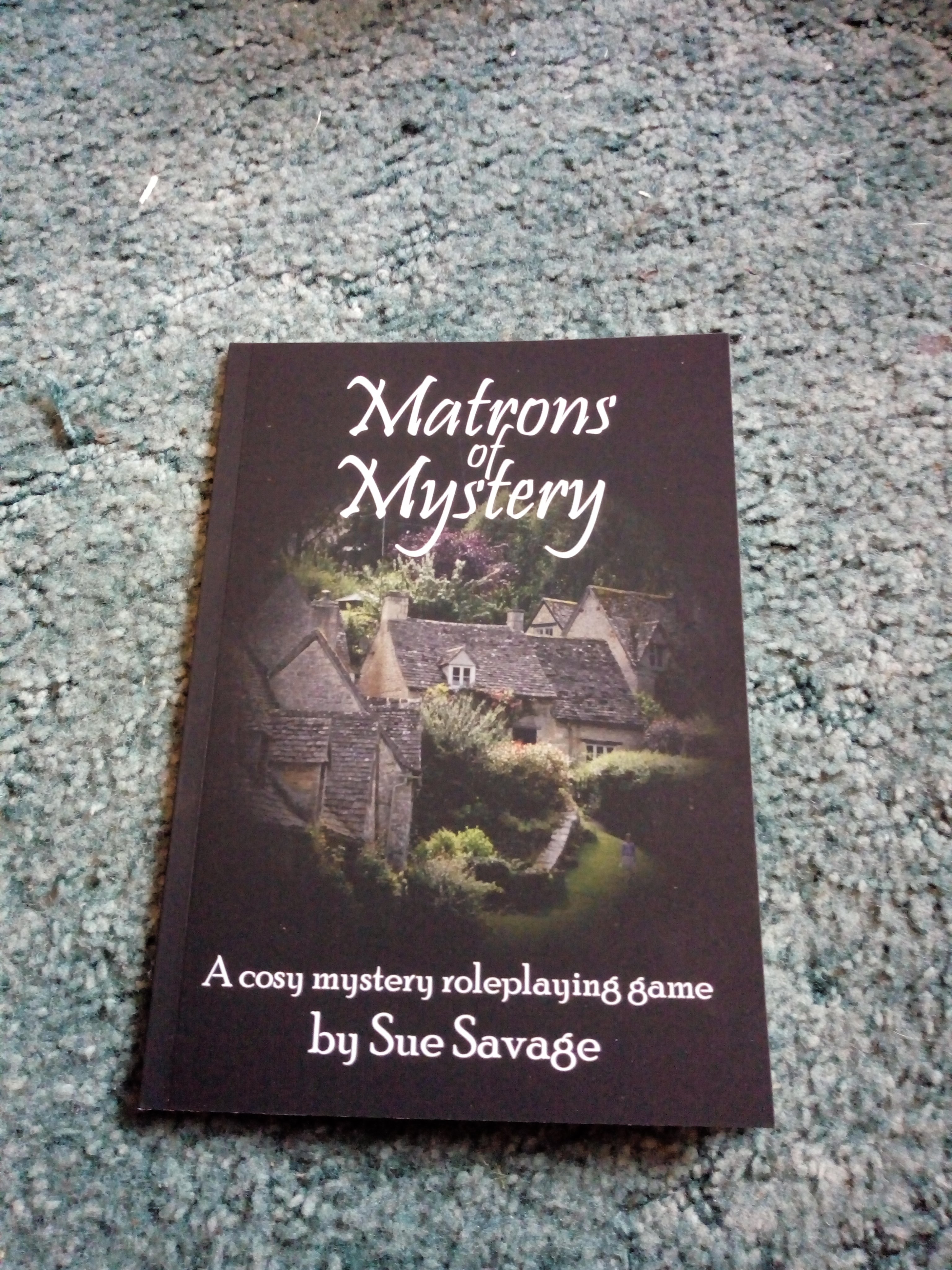
The Between is a game I picked up a while ago but only recently got the chance to play. It's a PBTA game like its predecessor, Brindlewood Bay, and uses the same Carved From Brindlewood mystery system. As a big fan of said mystery system I was keen to see how it ported over to this game.
The intro page explains that the game is directly inspired by the TV show Penny Dreadful, with some minor nods to other works. I initially thought it might be a game where you could play an adventure akin to Dracula, but no. When you get to the playbooks it becomes clear that this is Penny Dreadful, the RPG, as each one maps directly onto one of the main characters. If you're looking for a more generic gothic horror game, this isn't it.
Fortunately it's not necessary to be a Penny Dreadful fan to play the game. While the GM was a huge fan, the players were a mixed group. I'd watched some of it but not the whole thing, while some hadn't watched it at all. The Penny Dreadful characters are for the most part public domain characters, and the playbooks make it pretty clear who it is you're playing. While Brindlewood Bay's requirement that the PCs are all part of a book club and fans of the same book felt overly restrictive to me (what if you want to be a gardening club, or members of the WI?) the idea here that we were all monster hunters and residents of Hargrave House made total sense and didn't require any show knowledge to understand.
I picked the Vessel, (Vanessa Ives), while the other players went for the Mother (Victor Frankenstein), the Undeniable (Dorian Gray) and the American (Ethan Chandler (actually Lawrence Talbot)).
Like most PBTA games we kicked off with assigning stats and special moves, deciding what we looked like, and choosing names. Then there were the Personal Quarters. We went around each character in turn, and every player described an item that was in that characters's bedroom in Hargrave House. This was both interesting and frustrating. Interesting, because it provided a bit of insight into each character's personality. Frustrating, because these are all things that go on your character sheet and can supposedly be used in the game - except that none of them actually were, because they were in our rooms, and the mystery we were investigating was not in our rooms. Not a single item got so much as a mention after that point.
"...anything from the Personal Quarters that might reasonably be on a hunter’s person in a scene, is."
But as instructed by the game, we were all thinking of things that might be in someone's bedroom, not something they might be carrying around with them. One item we had in the Mother's room was a tank full of living flesh, which was not exactly something portable. And that was something from an AP chosen by the game designer himself.
Obviously this is an easy fix if you're running the game. Instead of personal quarters, frame it as items the PCs might happen to have with them. Then you've got a more freeform version of the equipment lists used by Blades in the Dark, and the items might actually get used.
On to the actual game. The Between has a strict play structure. If you're familiar with Blades in the Dark then you'll remember how it alternates between missions and downtime. This initially appears to be a rather more extreme version, with the four phases being Dawn, Day, Dusk and Night. It's not actually as complicated as it sounds though, as Dawn is just an upkeep phase, and Dusk is pretty much deciding what's going to happen in the Night phase.
The Day phase was all about investigating the mystery, or Threat as the game calls them. We played Sally No-Face, one of the included Threats, about a serial killer who removes people's faces with surgical precision. We went hunting for clues at the morgue and the scene of the most recent murder. We found horrible things, encountered troublesome NPCs, and generally had the kind of spooky fun I was hoping for.
...With one caveat: the Janus masks.
In Monster of the Week each character has a number of luck points. You can spend luck to improve a dice roll. You have a limited number of these, and very few options for regaining them, and running out means trouble. What's more, in the version we're playing, most playbooks have some kind of negative consequence for using luck. It's a mechanic I like a lot.
In The Between, spending a luck point is called 'invoking the Janus Mask.' Mechanically, they're fine. You have a set number available on your playbook, and each time you spend one you have to narrate something from your past. This is a great fit for the TV show theme, as character backstories are typically something you experience as a series of flashbacks at critical moments.
No, my issue (beyond the ridiculous name) is that the GM is supposed to narrate the bad outcome of the roll, even if they know that the player wants to use a mask to negate it. Why? Fortunately the book has an answer.
"Answer: because it’s fun! The Janus Mask lets us glimpse different timelines, play them out, feel them, experience the anguish and terror, and then… do something different."
Only it wasn't fun. There was no anguish and terror because we already knew it wasn't going to happen. All I felt was that we were wasting time and the GM's creativity, putting work into something that was going to be immediately retconned.
Again, this is an easy fix if you're running the game. Our GM rapidly quit bothering with the additional narration. Screw the rules; if it's as un-fun for you as it was for us, don't do it.
But back to the Threat. Like in Brindlewood Bay, the scenario provides a list of somewhat abstract clues that can be found when the characters are successful in their search for information. This is where the game really shines. It was creepy and atmospheric, and lead to some fantastic emotional scenes between characters as they had to deal with the conditions picked up over the course of the investigation. At last we'd collected enough clues to gather back at Hargrave House and discuss our findings, and work out what to do next.
What the game isn't clear about is when this is supposed to take place. Our group came up with our theory at the end of the Day phase, and then spent the Night phase dealing with the threat. This worked well, but with an otherwise rigidly laid out play structure, it's a bit odd that this doesn't seem to have any specific timing.
Something new in The Between's mystery system is that the complexity (and therefore the difficulty of the Answer A Question move) can vary depending on which question you want to answer. In theory I like the idea. In practice, it didn't go so well. Here's the questions for the Sally No Face threat:
WHERE IS THE KILLER HIDING? (Complexity: 4)
Resolve the Threat by infiltrating the killer’s lair, then capturing or
destroying them.
HOW IS THE KILLER CHOOSING THEIR VICTIMS? (Complexity: 6)
Resolve the Threat by luring the killer to you, then capturing or
destroying them.
WHAT IS THE TRUE IDENTITY OF THE KILLER, AND WHAT DROVE THEM TO THIS MADNESS? (Complexity: 8)
Resolve the Threat by empathizing with the killer, then bringing them in
peacefully.
And this became a problem. Because we were all the kind of players who want proper answers. We didn't just want to find the killer, we wanted to understand them! So obviously we were going for the third question. Except having answered that question successfully, we were now expected to empathise with the killer and bring them in peacefully. And there was not a lot of enthusiasm for that. We understood their motivations, but they were also a serial killer going round London cutting people's faces off. We wanted to take them down! And being told we weren't supposed to, just because we wanted to properly understand things, was bloody irritating.
If you've read this far you'll probably already have guessed that we did in fact end up taking them down when our efforts to bring them in peacefully failed due to a) them being a derranged serial killer, b) bad dice rolls, and c) not all of us actually wanting to do that.
There was a brief and somewhat unwelcome interruption to the dramatic finale in the form of the Unscene. This is a scene that takes place somewhere else in London while the Night phase is happening, and has absolutely nothing to do with the PCs, the threat, Hargrave House or anything else from the actual game. It consists of a series of prompts where the players take it in turn at intervals during the night phase to read out a prompt and then do what it says, usually narrating a scene.
The purpose of this is to provide a cinematic play experience and show parts of London's seedy underbelly. What it actually did for me, as the first player to get picked, was suddenly drag me away from the fun game I was having playing my Vanessa expy and shove me into something entirely unrelated. Doubtless someone finds this fun. I found it frustrating and tedious.
Another easy fix. If you also find the Unscene to be an unnecessary interruption to the game you were trying to play, throw it out. Our GM didn't ask any further prompts after mine.
So that's my experience of playing The Between for the first time. Incredibly atmospheric, innovatively designed, full of the kind of gothic horror I've loved since I was old enough to read Dracula, but at the same time extremely restrictive in what characters you can play and how the story unfolds, and hindered by weird design choices that kept pulling me out of the atmosphere and story.
It's something I'd consider playing again, because when the game wasn't getting in the way of its own fun it was genuinely excellent. And I'd consider running it, but only with all the changes I've described above. And probably after I get round to watching the rest of Penny Dreadful.